

Why Are US Calls Labeled "Spam Likely"? (And How to Fix It)

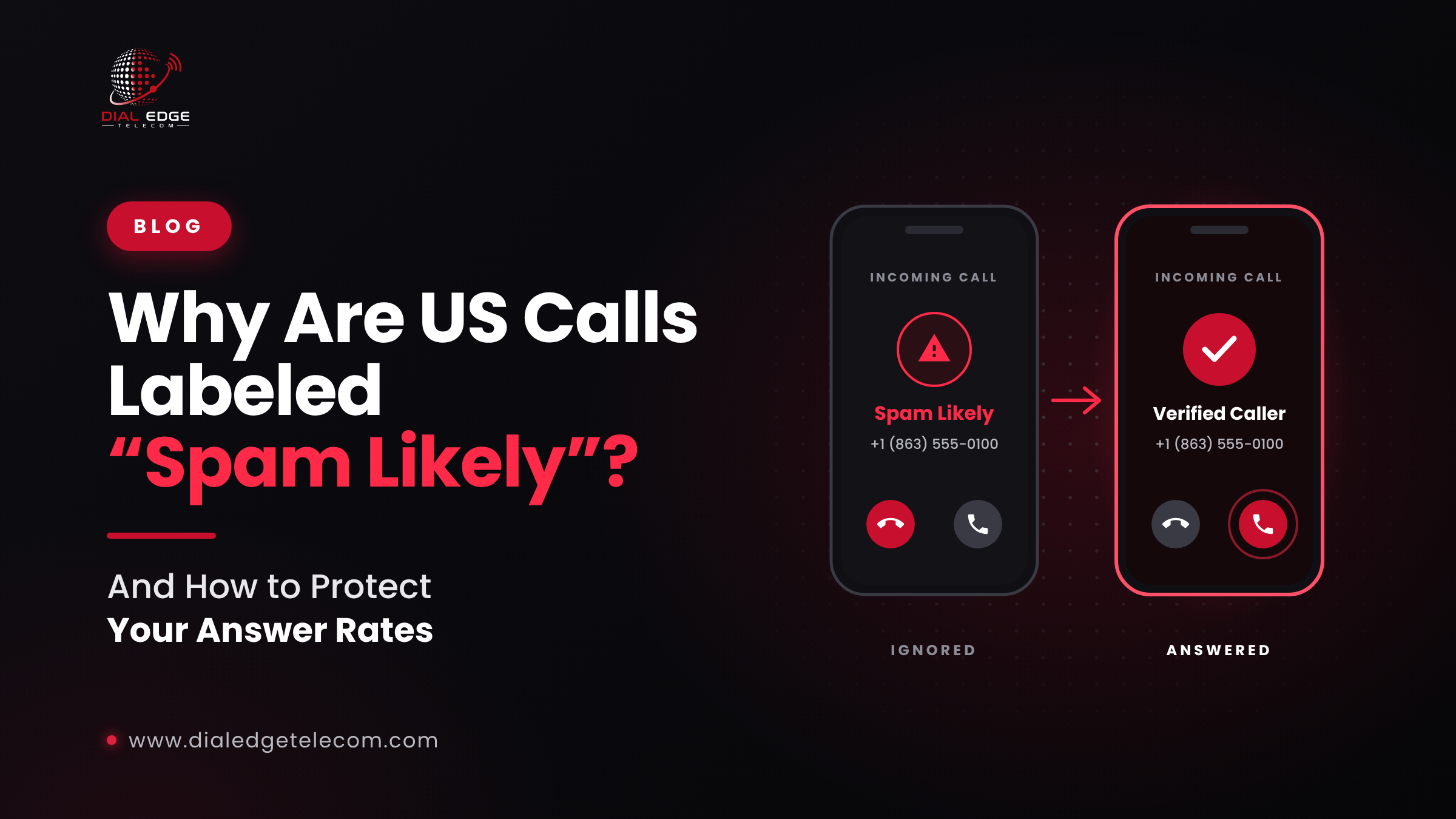
Why Are US Calls Labeled "Spam Likely"?
You run a legitimate business. Your agents are calling real customers who expect to hear from you. And yet, on their screens, your calls show up as "Spam Likely."
It's one of the most common, and most frustrating, problems for US call centers and sales teams. A spam label can cut your answer rates sharply, because most people simply won't pick up.
The good news: these labels aren't random. Once you understand why they happen, you can take steps to prevent them.
What does "Spam Likely" mean?
"Spam Likely" (or "Scam Likely," "Potential Spam," "Telemarketer" and similar warnings) is a label that a mobile carrier or call-analytics service adds to an incoming call. It's a prediction that the call may be unwanted.
Some key facts:
It isn't a legal ruling. It's an automated judgment based on data.
Each carrier decides on its own. Major US mobile carriers use their own call-analytics systems. Your number might be flagged on one network and look perfectly normal on another.
It can change over time. Labels are based on recent behavior, so improving how you call can improve how your number is labeled.
How do carriers decide a call is spam?
Analytics systems look at huge amounts of call data and score each number. While every system is different, these are the most common factors.
1. High call volume from one number
If a single number places hundreds or thousands of calls a day, it looks like a robocaller, even if every call is legitimate.
2. Short call durations
Lots of very short calls, where people hang up within seconds, suggest the calls aren't wanted.
3. Low answer rates
If most calls from a number go unanswered or are quickly declined, analytics systems take that as a warning sign.
4. Consumer complaints and reports
When people block your number, report it as spam in their phone app or file complaints, it counts against you.
5. Weak or missing call authentication
Under STIR/SHAKEN, every call carries an attestation level: A (full), B (partial) or C (gateway). Calls with lower attestation, or none at all, are treated with more suspicion. (Read more: What Is STIR/SHAKEN?)
6. Calling invalid or disconnected numbers
Dialing large numbers of disconnected or never-assigned numbers looks like random dialing, a classic robocall pattern.
7. Brand-new numbers with no history
A new number that suddenly starts making lots of calls has no reputation to protect it.
8. Recycled numbers
Sometimes a number you're given was previously used by someone else, and it may have carried a spam reputation before it ever reached you.
9. Caller ID problems
Calls where the caller ID is missing, changed along the route or doesn't match the caller are more likely to be flagged. This is one reason route quality matters.
10. Suspicious calling patterns
Switching between many different numbers very quickly, or calling numbers in sequence, can also look like robocaller behavior.
Why it matters for your business
A "Spam Likely" label can:
Lower answer rates, so agents spend more time waiting and less time talking
Reduce callbacks, because people won't return a call they think is spam
Hurt your brand, since customers associate your business with unwanted calls
Waste money on calling time and agent hours that don't produce conversations
How to check if your numbers are flagged
Call your own phones on several different mobile networks and see how your number appears.
Track answer rates by number. A sudden drop on one number often means it's been flagged.
Use number-reputation monitoring tools, which many providers and third-party services offer.
Listen to customers. If people say "your call showed up as spam," take it seriously.
How to prevent "Spam Likely" labels
Use clean, authenticated numbers
Use numbers your business owns or is authorized to use, such as DIDs from your provider.
Choose a provider that supports STIR/SHAKEN and can give your calls strong attestation.
Never spoof caller ID.
Register your numbers
Register your business numbers with the major call-analytics providers. Several of them accept registrations through a shared Free Caller Registry portal. Registration tells them who you are and how you use your numbers.
Manage your call volume
Spread calls across enough numbers so no single number is overloaded.
Avoid rotating through numbers too aggressively, which can also look suspicious.
Retire numbers that have been flagged, and let them rest.
Clean your calling lists
Remove disconnected, invalid and wrong numbers.
Scrub your lists against the National Do Not Call Registry and your internal do-not-call list.
Call people who expect to hear from you, with consent where required.
Call responsibly
Call during reasonable hours in the recipient's local time zone.
Keep abandoned calls low when using predictive dialers.
Make sure agents are ready to talk when calls connect.
Use quality routes
Choose a provider with direct, high-quality routes that deliver your caller ID correctly. Low-cost grey routes can strip or alter caller ID, making your calls look suspicious.
Request a review if you're flagged
If a number is wrongly labeled, you can ask the carrier or its analytics partner to review it. Many offer online request forms for businesses. Fixing the underlying cause first gives your request the best chance of success.
Spam protection with Dial Edge Telecom
Dial Edge Telecom helps call centers, carriers and enterprises across the US and Canada keep their calls trusted:
STIR/SHAKEN support at all attestation levels: Full (A), Partial (B) and Gateway (C)
Caller ID validation: spoofed, unassigned and malformed numbers are rejected
Robocall pattern detection and caller ID spoofing protection
Do Not Call enforcement support for outbound dialers
Direct Tier-1 routes with no grey-route intermediaries
24/7 network monitoring
Want more of your calls answered? Talk to our team, email sales@dialedgetelecom.com or call +1-863-513-5237.