

What Is VoIP Termination and How Does It Work?

What Is VoIP Termination and How Does It Work?
Every outbound call your business makes has to end somewhere: on a customer's mobile, an office landline or another company's phone system. Getting it there reliably, clearly, and at the right price is the job of VoIP termination.
If you run a call center, resell voice services, or operate as a carrier, termination is one of the most important parts of your voice setup. Here's what it is, how it works, and what to look for in a provider.

What is VoIP termination?
VoIP termination is the process of delivering an outbound call from an IP network to its final destination, whether that's a mobile number, a landline, or another VoIP network.
The call "terminates" when it reaches the network that serves the number you dialed.
It's the opposite of VoIP origination, which brings incoming calls from the phone network onto your VoIP system.
Termination = outbound calls (you call your customers)
Origination = inbound calls (your customers call you)
How does VoIP termination work?
Here's what happens in the few seconds after you dial:
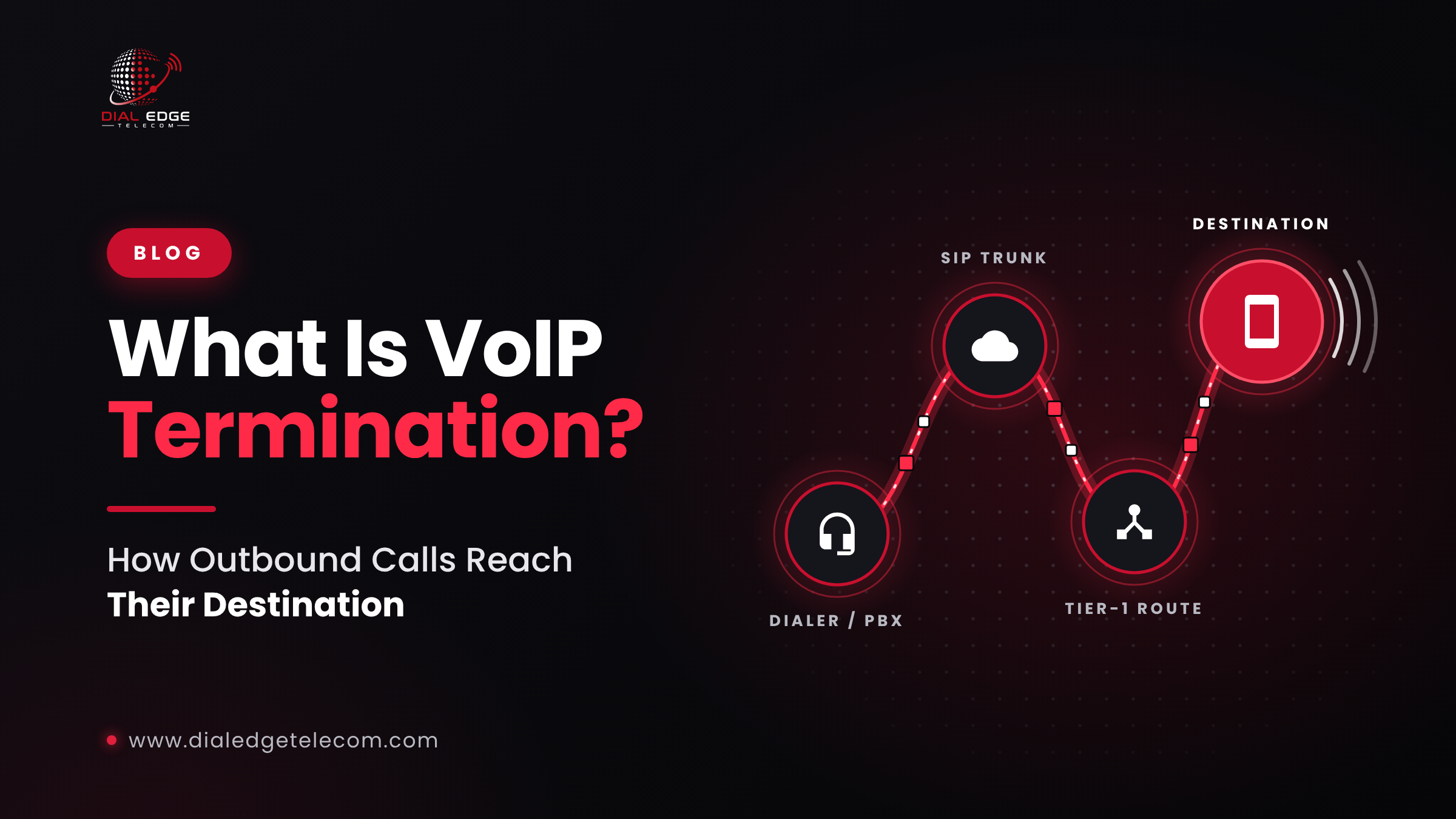
The call starts. An agent dials a number, or a dialer launches the call automatically, from a PBX, softphone or dialer platform.
It's sent to your termination provider. The call travels over a SIP trunk, a virtual phone line over the internet, to your provider.
The provider checks the number. Its systems identify the destination: the country, the area code and which carrier owns the number.
The best route is selected. Using Least Cost Routing (LCR) and quality data, the provider picks the route that balances call quality and cost.
The call is handed to the destination carrier. It travels through the provider's network and its carrier partners to the mobile or landline network that serves the number. If needed, a gateway converts it from IP to that network's format.
The phone rings. The person answers, and the voice flows both ways in real time.
The call is recorded for billing. When it ends, a call record is created with its duration and destination, and billed at the agreed rate.
All of this happens in milliseconds. The quality of the route chosen in step 4 decides whether the call sounds clear or breaks up.
Types of VoIP termination
Wholesale vs. retail termination
Wholesale termination is sold in bulk to carriers, VoIP resellers and call centers that send large volumes of calls. Rates are per minute and usually much lower than retail. Retail termination is bundled into business phone plans for everyday users.
A-Z termination
Coverage to all, or nearly all, destinations worldwide through a single provider, so you don't need a separate supplier for each country.
CLI vs. non-CLI routes
CLI (Calling Line Identification) routes deliver your caller ID correctly to the person you're calling. Non-CLI routes may not, which makes calls look unknown or suspicious. For sales and customer calls, CLI routes are essential.
Dialer termination
Routes built for predictive and power dialers that send high volumes of short outbound calls. They need high CPS (calls per second) capacity and stable performance under heavy load.
What affects termination quality?
Route quality
Tier-1 routes go through major carriers with direct connections, with fewer hand-offs between networks. That means less delay and clearer audio. Grey routes are cheaper, unofficial paths that bypass normal agreements, and they often lead to poor audio, failed calls, and missing caller ID.
Key quality measures
ASR (Answer-Seizure Ratio): the percentage of calls that are answered
ACD (Average Call Duration): very short averages can signal quality problems
PDD (Post-Dial Delay): the wait between dialing and hearing ringing
CPS capacity: how many new calls you can start per second
STIR/SHAKEN
In the US and Canada, STIR/SHAKEN verifies that caller ID is genuine. Properly signed calls are less likely to be marked "Spam Likely," which directly protects your answer rates.
How is VoIP termination priced?
Termination is usually billed per minute, and rates vary by destination. In the US and Canada, prices can vary by area code and exchange (NPA-NXX).
Pay close attention to billing increments:
1/1: billed per second
6/6: a 6-second minimum, then 6-second blocks
60/60: every call rounded up to a full minute
Example: a 20-second call is billed as 20 seconds on 1/1, 24 seconds on 6/6, and a full 60 seconds on 60/60. For call centers making thousands of short calls a day, that difference adds up quickly.
Remember, the cheapest rate isn't always the best option. Low-quality routes mean more failed calls, lower answer rates, and wasted agent time.
How to choose a VoIP termination provider
Before you sign, ask:
Which routes will my calls use? Look for Tier-1, CLI routes.
What uptime do you guarantee?
How much CPS can you support, and how fast can it grow?
Do you fully support STIR/SHAKEN?
Is technical support available 24/7?
Are your rates transparent, with no hidden fees?
Can I test the routes with my real traffic first?
A good provider will answer every question clearly and let you see results before you commit.
Reliable VoIP termination with Dial Edge Telecom
Dial Edge Telecom delivers wholesale voice termination built for call centers, carriers, and enterprises across the US and Canada:
Tier-1 voice routes for clear, consistent calls
99.99% uptime
Premium dialer termination for high-volume outbound traffic
Dedicated SIP trunks that scale with you
Transparent rates. No hidden fees.
Ready to improve your call quality and answer rates? Get a custom VoIP termination quote, email sales@dialedgetelecom.com or call +1-863-513-5237.