

What Is STIR/SHAKEN? Call Authentication Explained.
What Is STIR/SHAKEN?
Robocalls and fake caller IDs have made people wary of answering their phones. For businesses that rely on outbound calls, that's a serious problem: if customers don't trust the number on their screen, they don't pick up.
STIR/SHAKEN was created to fix that trust problem. If your business makes calls in the US or Canada, here's what you need to know.
What is STIR/SHAKEN?
STIR/SHAKEN is a call authentication framework that verifies whether the caller ID on a call is genuine. It helps phone networks spot spoofed calls, where someone fakes the number that appears on your screen.
The name combines two sets of technical standards:
STIR (Secure Telephone Identity Revisited): the standards for digitally "signing" a call's caller ID
SHAKEN (Signature-based Handling of Asserted Information using toKENs): the rules for how phone companies put those standards into practice on their networks
Think of it as a digital seal on every call. The seal shows which provider started the call and how confident that provider is that the caller is allowed to use the number shown.
Why was STIR/SHAKEN created?
Caller ID was designed decades ago, when there were few phone companies and little reason to fake a number. With VoIP, it became easy to make a call show any number at all. Scammers took advantage, using fake local numbers to trick people into answering.
To fight this, regulators required phone companies to adopt STIR/SHAKEN:
United States: under the TRACED Act, the FCC required voice providers to implement STIR/SHAKEN on their IP networks. Most major providers had to comply by June 30, 2021, and the rules have expanded since.
Canada: the CRTC required providers to implement STIR/SHAKEN for IP-based calls from November 30, 2021.
How does STIR/SHAKEN work?
You place a call. Your phone system or dialer sends the call to your voice provider.
Your provider checks the caller. It looks at who you are as a customer and whether you're authorized to use the caller ID number.
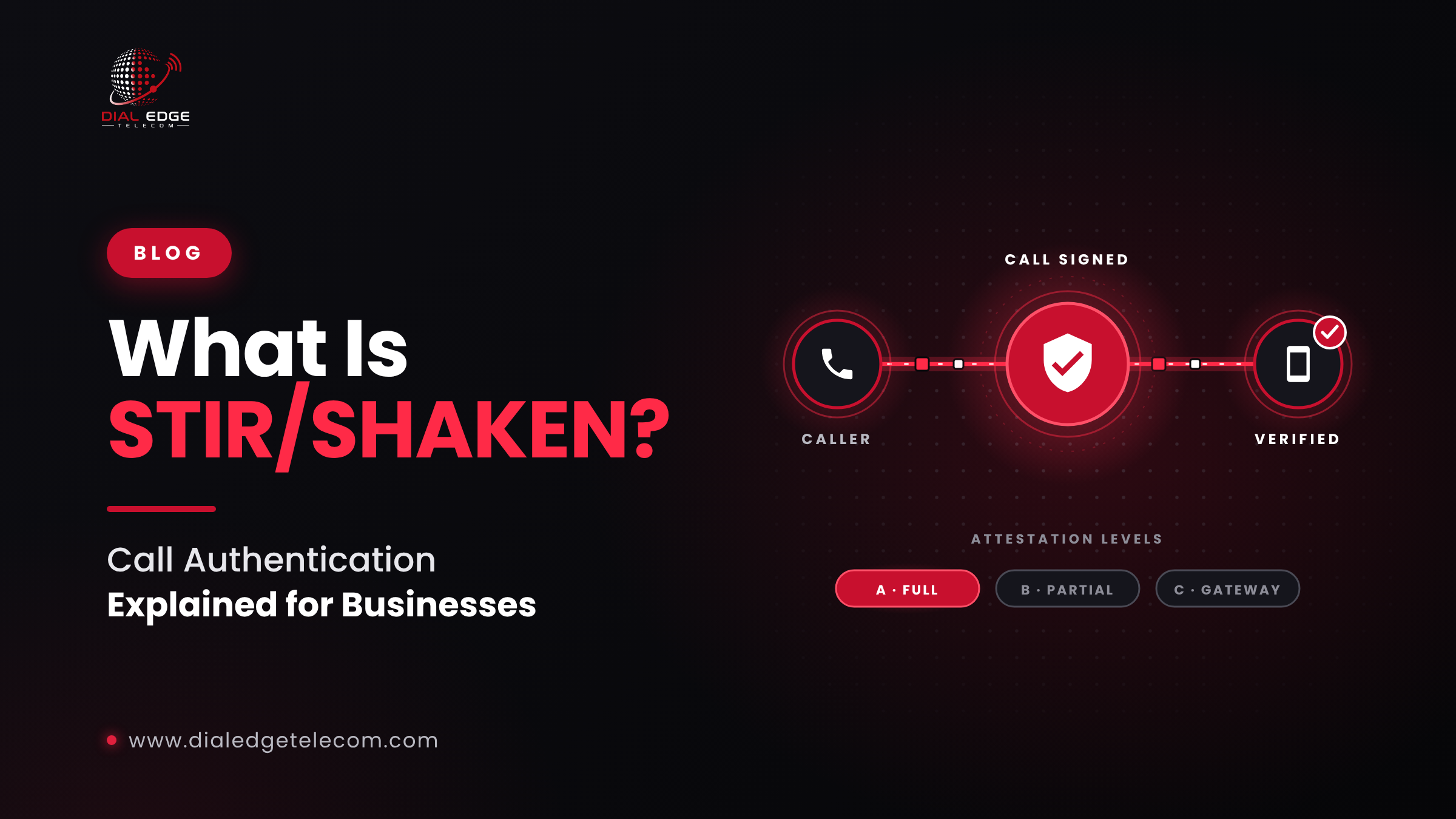
Your provider signs the call. It adds a secure digital signature to the call, including an attestation level (A, B or C), using a certificate issued through an official authority.
The call travels across networks with the signature attached.
The receiving provider verifies the signature. It checks that the signature is valid and that the call information hasn't been tampered with.
The call is delivered. The receiving provider uses the result, along with its own call analytics, to decide how to present the call: as verified, as possible spam, or, in some cases, by blocking it.
What do attestation levels A, B, and C mean?
The attestation level shows how confident the originating provider is about the caller:
Level | Name | What it means |
|---|---|---|
A | Full attestation | The provider knows the customer and confirms they're authorized to use the caller ID number. |
B | Partial attestation | The provider knows the customer, but can't confirm they're authorized to use that specific number. |
C | Gateway attestation | The provider is passing the call along but can't verify where it came from, for example, a call arriving from another network. |
For businesses, A attestation is the goal. Calls with full attestation are generally the most trusted by receiving networks.
How does STIR/SHAKEN affect your business?
Answer rates
Receiving carriers and call-analytics apps use attestation as one of many signals when deciding whether to label a call "Spam Likely" or "Scam Likely." Calls without strong attestation are more likely to be flagged, and flagged calls rarely get answered.
Customer trust
On some phones, verified calls show a checkmark or "verified" indicator. That helps customers feel confident picking up.
Choosing a provider
Your attestation level depends on your provider and your numbers. If your provider can't verify that you're allowed to use your caller ID, your calls may get B or C attestation, even if your business is completely legitimate.
What STIR/SHAKEN doesn't do
It doesn't block calls by itself. It provides information; carriers and analytics decide what to do with it.
It doesn't judge the purpose of a call. A legitimate caller with an attestation can still be labeled spam if their calling patterns look suspicious.
It doesn't work everywhere. STIR/SHAKEN works on IP networks. When a call passes through older, non-IP parts of the phone network, the signature can be lost.
It doesn't replace compliance. You still need to follow Do Not Call rules, calling-time restrictions, and consent requirements.
How to get the most from STIR/SHAKEN
Use numbers you own or are authorized to use, such as DID numbers from your provider. Never spoof caller ID.
Choose a provider that fully supports STIR/SHAKEN and can give your calls an A attestation.
Keep your numbers' information up to date with your provider.
Register your numbers with call-analytics services where possible, so they recognize your business.
Watch your calling patterns. Very high volumes from one number, or many short calls, can trigger spam labels.
Monitor answer rates and replace numbers that get flagged.
Questions to ask your provider
Do you fully support STIR/SHAKEN on my calls?
What attestation level will my calls receive, and why?
Do you verify caller ID numbers before calls are sent?
How do you help when my numbers are flagged as spam?
Do you monitor for spoofing and robocall patterns?
STIR/SHAKEN support with Dial Edge Telecom
Dial Edge Telecom helps call centers, carriers, and enterprises across the US and Canada send trusted, authenticated calls:
STIR/SHAKEN support at all attestation levels: Full (A), Partial (B), and Gateway (C)
Caller ID validation: originating numbers are checked against registries and STIR/SHAKEN, and spoofed or unassigned numbers are rejected
Caller ID spoofing protection and robocall pattern detection
24/7 network operations center (NOC) monitoring
Do Not Call enforcement support for outbound dialers
Direct Tier-1 routes with no grey-route intermediaries
Want more of your calls answered? Get a custom quote, email sales@dialedgetelecom.com or call +1-863-513-5237.