

What Is a Tier-1 VoIP Carrier?

What Is a Tier-1 VoIP Carrier?
If you've shopped for VoIP services, you've probably seen phrases like "Tier-1 carrier" or "Tier-1 routes" on almost every provider's website. It sounds impressive, but what does it actually mean? And does it really make a difference to your calls?
For call centers, resellers, and businesses that rely on voice, the answer is yes. The tier of carrier your calls travel through has a direct impact on call quality, answer rates, and reliability. Here's a plain-English explanation.
What is a Tier-1 VoIP carrier?
A Tier-1 carrier is a large telecom provider that owns its own extensive network and connects directly with other major networks, so it can deliver calls to their destination without paying or relying on several middlemen along the way.
In the US and Canada, Tier-1 carriers are typically the large national phone companies that own the infrastructure most calls travel over: fiber networks, switching equipment, and direct connections (called interconnects) to the mobile and landline networks that serve your customers.
Because they sit at the top of the voice network, Tier-1 carriers can carry a call most of the way, or all the way, to the person you're calling on their own network.
Tier-1 vs. Tier-2 vs. Tier-3 carriers
Not every VoIP provider owns a network. Most of the industry is built in layers:
Tier-1 | Tier-2 | Tier-3 | |
|---|---|---|---|
Network | Owns a large national network | Owns a smaller or regional network | Usually owns little or no network |
How it reaches destinations | Directly, through its own network and interconnects | Partly its own network, partly buys routes from Tier-1 carriers | Buys routes from Tier-1 or Tier-2 carriers and resells them |
Hand-offs per call | Very few | Some | Often many |
Typical customers | Other carriers and very large enterprises | Providers, resellers, businesses | Small businesses and end users |
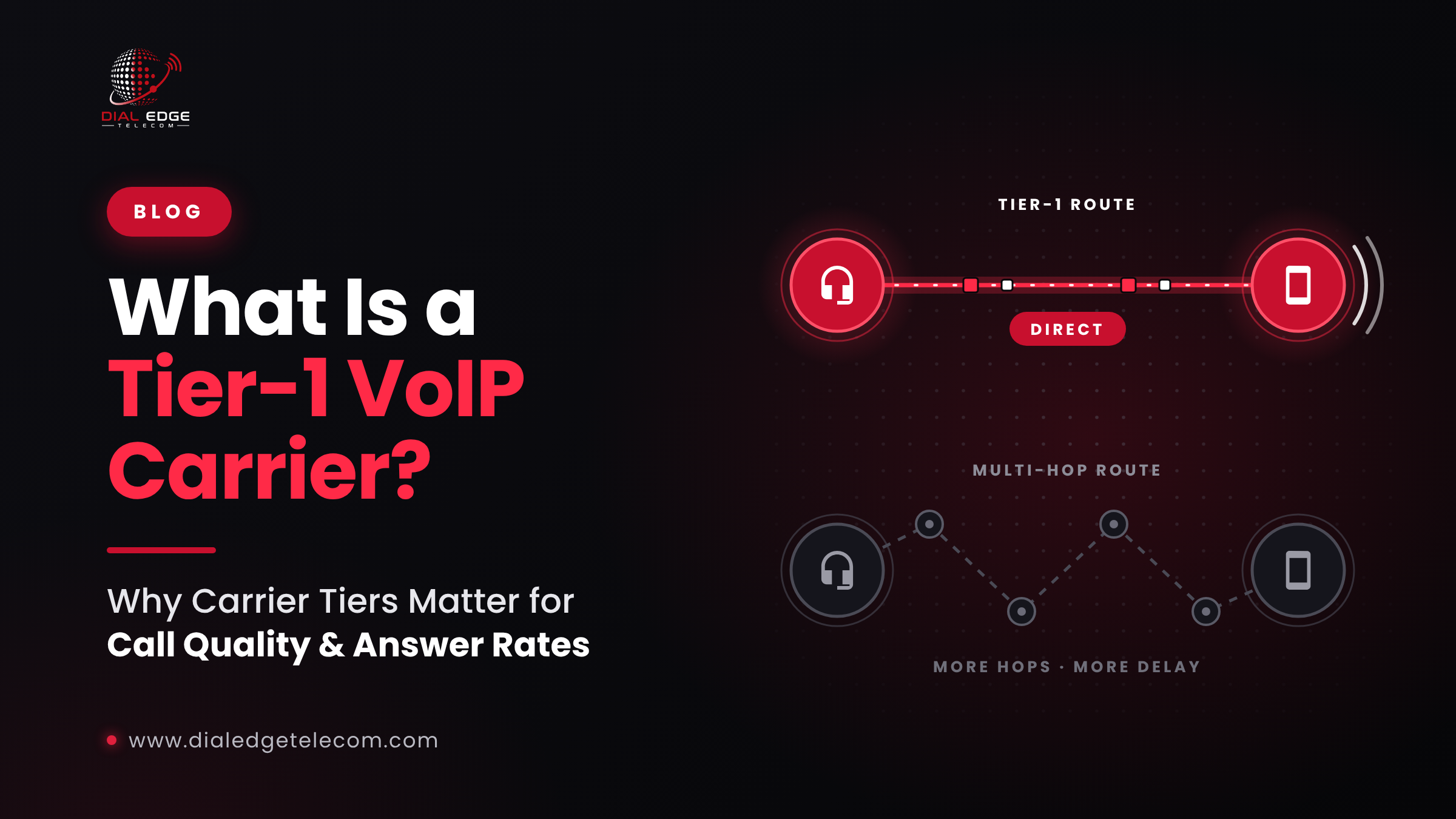
A simple way to think about it: a Tier-1 carrier is like a major airline flying direct. A Tier-3 provider might sell you the same destination, but with several connecting flights along the way.
How a call travels: why hand-offs matter
Every time a call is passed from one carrier to another, it's called a hand-off (or a "hop"). Each hand-off adds:
Delay: a little more time for your voice to reach the other person
Risk of quality loss: audio may be converted or compressed again, causing choppy or robotic sound
Risk of failure: one more place where the call can drop or fail to connect
Risk of losing caller ID: your number may not be passed along correctly
A call sent over Tier-1 routes typically has very few hand-offs between your provider and your customer's phone. A call sent through a chain of low-cost resellers may pass through several networks, and sometimes over grey routes that bypass normal carrier agreements to cut costs.
Benefits of Tier-1 voice routes
1. Clearer call quality
Fewer hand-offs mean lower delay, less jitter, and fewer audio problems. Conversations sound natural, without echoes, gaps, or people talking over each other.
2. Higher answer rates
Tier-1 routes are more likely to deliver your caller ID correctly and support call authentication like STIR/SHAKEN. That means your calls are less likely to show up as "Spam Likely," and more people pick up.
3. Better reliability
Tier-1 networks are built with redundancy and monitored around the clock. Calls connect consistently, even at busy times.
4. Higher capacity
Large networks can handle high call volumes and high CPS (calls per second), which is essential for call centers running predictive or power dialers.
5. Fewer surprises
With fewer companies in the chain, it's easier to trace and fix problems when something goes wrong.
Do you have to buy directly from a Tier-1 carrier?
Not usually. Major Tier-1 carriers tend to work with other carriers and very large enterprises, with high minimum volumes, long contracts, and complex onboarding.
That's why many businesses work with a wholesale VoIP provider that delivers Tier-1 routes. The provider connects to Tier-1 networks, then gives you access to that quality with:
Flexible capacity that matches your traffic
Faster setup and simpler contracts
Dedicated technical support
Clearer pricing for your specific destinations
You get the call quality of Tier-1 routes without needing the volume of a national carrier.
Is every "Tier-1" claim true?
Here's something every buyer should know: "Tier-1" is an industry term, not an official certification. No regulator hands out a "Tier-1" label, and some providers use it loosely in their marketing.
Before you trust a "Tier-1" claim, ask:
Which networks will my calls actually go over?
How many hand-offs do my calls typically make before reaching the destination?
Do you deliver caller ID (CLI) correctly on every call?
Do you fully support STIR/SHAKEN?
Can I test the routes with my own traffic first?
Will you share quality reports like ASR (answer rate) and ACD (average call duration)?
A provider with real Tier-1 routes will answer clearly and let the results speak for themselves.
Is Tier-1 worth the cost?
Tier-1 routes can cost slightly more per minute than the cheapest options on the market. But for any business where calls matter, the real cost of cheap routes is much higher:
Missed sales from dropped or unanswered calls
Wasted agent time waiting for calls to connect
Damaged reputation when customers hear poor audio or see "Spam Likely"
Lost numbers that get flagged and need replacing
For call centers, carriers, and resellers, a slightly higher rate on quality routes usually pays for itself through better connection rates and more productive agents.
Tier-1 voice routes with Dial Edge Telecom
Dial Edge Telecom delivers wholesale voice services over Tier-1 voice routes for call centers, carriers, and enterprises across the US and Canada:
Tier-1 voice routes for crystal-clear, consistent call quality
99.99% uptime
Dedicated SIP trunks that scale with your traffic
Transparent rates. No hidden fees.
Want to hear the difference? Get a custom rate quote, email sales@dialedgetelecom.com or call +1-863-513-5237.