

What Is a SIP Trunk? A Simple Guide to SIP Trunking.

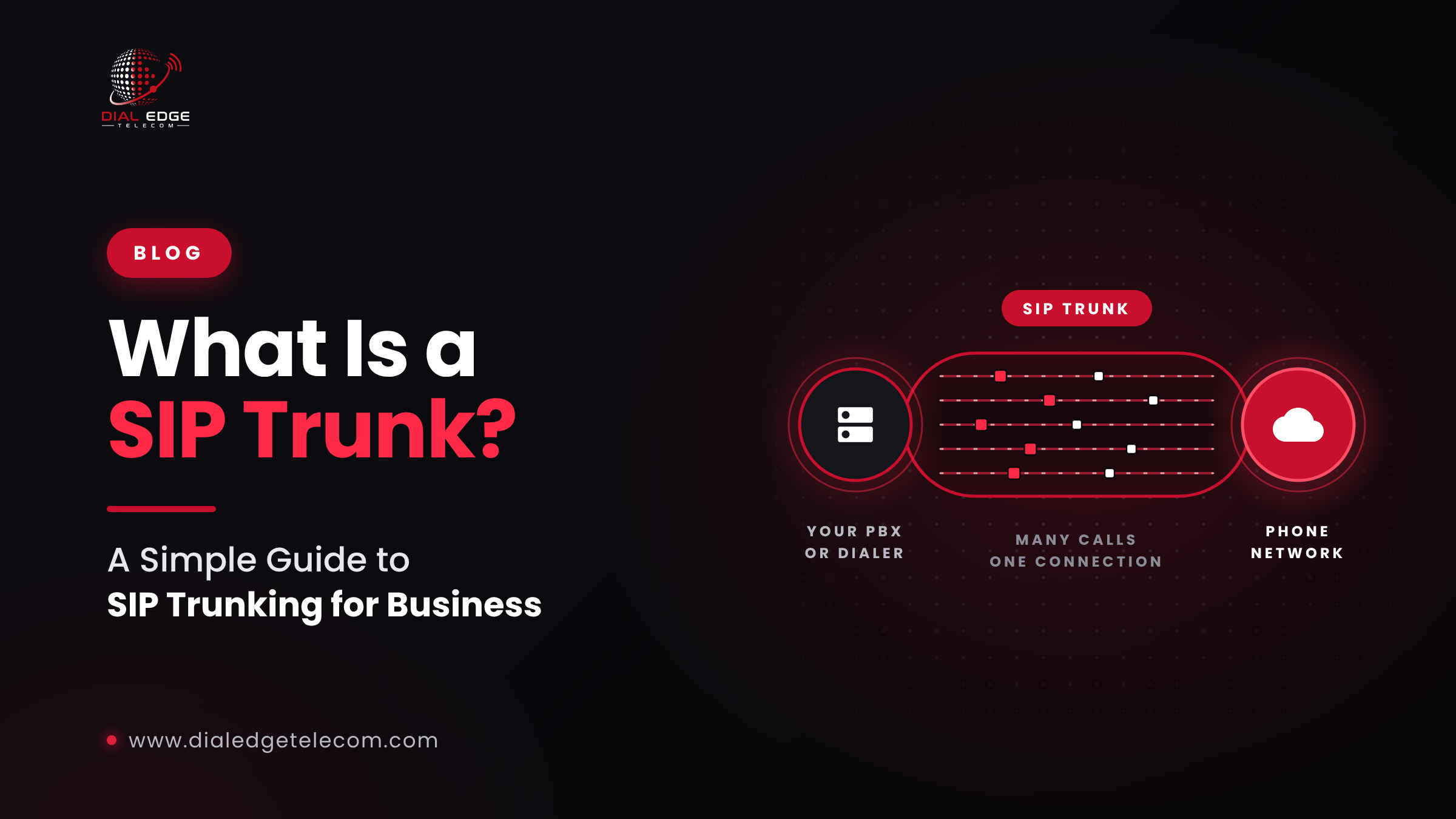
What Is a SIP Trunk?
For decades, businesses connected their phone systems to the outside world with physical phone lines: bundles of copper wires, each carrying a limited number of calls. Adding capacity meant waiting for new lines to be installed.
Today, most businesses do it over the internet instead, using SIP trunks. Here's what they are, how they work and why call centers, carriers, and growing businesses rely on them.
What is a SIP trunk?
A SIP trunk is a virtual phone line that connects your phone system to the public phone network over the internet (or a private data connection).
It lets your business make and receive calls to any phone number without traditional phone lines.
The name has two parts:
SIP (Session Initiation Protocol) is the technology that sets up, manages and ends VoIP calls.
Trunk is an old telecom term for a line that carries many calls at once between two systems.
So a SIP trunk is a connection that carries many calls at once, using SIP.
How does a SIP trunk work?
A SIP trunk sits between your phone system and your provider's network:
Your system places a call. An agent dials from a desk phone, softphone or dialer connected to your PBX (your business phone system) or dialing platform.
The call goes over the SIP trunk. Your system sends the call to your SIP trunk provider over your internet or data connection.
The provider routes the call. The provider sends it over its voice routes to the destination network: a mobile, a landline or another VoIP system.
The phone rings, and the conversation flows both ways in real time.
Inbound calls work the same way in reverse. Someone dials one of your phone numbers (DIDs), and the provider sends the call down your SIP trunk to your system, which rings the right person or team.
What are SIP channels?
A channel (sometimes called a "session") is capacity for one call at a time. If you have 50 channels, you can have 50 calls running at once.
For call centers, two numbers matter most:
Concurrent channels: how many calls can be active at the same time
CPS (calls per second): how many new calls you can start each second, which is critical for dialers
SIP trunks vs. traditional phone lines (PRI)
Before SIP trunks, many businesses used PRI lines, physical circuits that each carry up to 23 calls in North America.
Traditional PRI lines | SIP trunks | |
|---|---|---|
Connection | Physical copper circuits | Over the internet or a data connection |
Capacity | Fixed blocks (23 calls per PRI) | Add or remove channels as needed |
Scaling | New lines must be installed | Changed in minutes or hours |
Cost | Monthly per-line fees, often higher call rates | Pay for the capacity you need, usually lower rates |
Location | Tied to one physical site | Can serve multiple sites and remote teams |
Redundancy | Line failure means calls stop | Calls can automatically reroute to backup paths |
SIP trunks vs. hosted PBX: what's the difference?
Hosted PBX (cloud phone system): your provider runs the whole phone system for you in the cloud. Best for businesses that want a ready-made system with features included.
SIP trunk: you keep your own phone system or dialer and use the SIP trunk to connect it to the phone network. Best for businesses that want control over their setup, already own a PBX or dialer, or have high call volumes.
Most call centers, carriers and resellers use SIP trunks.
Shared vs. dedicated SIP trunks
Shared SIP trunks use capacity that's shared with the provider's other customers. They're simpler and cheaper, but performance can dip at busy times.
Dedicated SIP trunks reserve capacity exclusively for your traffic. Your calls aren't competing with anyone else's, so performance stays consistent, even at peak hours. For high-volume call centers, dedicated trunks are usually the safer choice.
Benefits of SIP trunking
Lower costs: no physical lines to rent, and usually lower per-minute rates.
Easy scaling: add channels for a new campaign or team quickly, without new installations.
Flexibility: connect multiple offices and remote agents to the same system.
Reliability: with redundant routing, calls can automatically switch to a backup path if one fails.
Works with what you have: SIP trunks connect to most modern IP-PBX systems, dialers and contact center platforms.
Better control: you choose your phone system, features and setup.
What do you need to use a SIP trunk?
A SIP-compatible phone system or dialer: most modern IP-PBX systems and contact center platforms support SIP.
A reliable internet or data connection: each call typically needs around 100 kbps in each direction with the common G.711 codec, so plan bandwidth for your busiest times.
A SIP trunk provider.
Phone numbers (DIDs) if you want to receive inbound calls.
The right network setup: firewall and router settings that allow voice traffic, ideally with QoS (Quality of Service) to prioritize calls.
Keeping SIP trunks secure
Because SIP trunks run over data networks, security matters:
Use IP-based authentication so only your systems can send calls
Use strong passwords wherever credentials are used
Encrypt calls where supported (TLS for signaling, SRTP for audio)
Set spending limits and alerts for unusual traffic
Choose a provider with fraud monitoring that can block suspicious calls automatically
How to choose a SIP trunk provider
Ask these questions:
Are your SIP trunks shared or dedicated?
How many channels and how much CPS can I get, and how fast can it grow?
Do you include redundant routing and automatic failover?
Which routes will my calls use? Are they direct, Tier-1 routes?
Do you support STIR/SHAKEN?
Is technical support available 24/7?
Is pricing clear and based on my actual traffic?
Dedicated SIP trunks with Dial Edge Telecom
Dial Edge Telecom provides dedicated SIP trunks for call centers, carriers and enterprises across the US and Canada:
Dedicated capacity reserved exclusively for your traffic
Custom CPS limits set to your actual needs
API provisioning, so trunks can be set up, scaled or changed programmatically
Redundant routing with automatic failover to a backup path
Direct Tier-1 routes with no grey-route intermediaries
STIR/SHAKEN support and 24/7 network monitoring
Custom rates tailored to your volume
Ready to connect? Request a SIP trunk quote, email info@dialedgetelecom.com or call +1-863-513-5237.