

What Are VoIP Routes, and How Do Carriers Choose Them?

What Are VoIP Routes, and How Do Carriers Choose Them?
When you dial a number, your call doesn't take one fixed path. Behind the scenes, your provider makes a split-second decision about which route the call should travel to reach the person you're calling. That decision affects how clear the call sounds, whether it connects at all, and what it costs.
For call centers, resellers and carriers, understanding VoIP routes is the key to better call quality and higher answer rates. Here's how it works.
What is a VoIP route?
A VoIP route is the path a call takes from your phone system to the network of the person you're calling.
That path may run through your provider's own network, one or more partner carriers, and finally the mobile or landline network that serves the number. Each company along the way is a "hop."
A good route gets the call there quickly, clearly and reliably, with your caller ID intact. A poor route adds delay, drops calls or delivers them with poor audio.
The main types of VoIP routes
Direct (Tier-1) routes
These go through major carriers with direct connections to destination networks, with very few hops. They give the best call quality and reliability. (Read more in our guide: What Is a Tier-1 VoIP Carrier?)
CLI and non-CLI routes
CLI (Calling Line Identification) routes pass your caller ID correctly to the person you're calling. Non-CLI routes may not, so your call can show up as unknown, a random number or "Spam Likely." For business calls, CLI routes are essential.
Premium vs. standard routes
Premium routes prioritize quality and consistency. Standard (or "wholesale") routes focus more on price. Many providers offer both, so customers can match the route to the type of traffic.
Dialer routes
These are built for predictive and power dialers that send high volumes of short calls. They need high CPS (calls per second) capacity and stable performance under heavy load.
Grey routes
Grey routes bypass normal carrier agreements to cut costs. They're cheap, but often unreliable, with poor audio, missing caller ID and calls that suddenly stop working. Reputable providers avoid them.
How do carriers choose a route?
Every time you place a call, your provider's routing system looks at several factors in milliseconds. Here are the most important ones.
1. Where the number lives
First, the system works out exactly where the call needs to go. In the US and Canada, this starts with the number's area code and exchange (NPA-NXX). Because people can keep their numbers when they switch providers, carriers also check a number portability database to find which carrier currently serves that number. This lookup is known as an LRN dip (Local Routing Number).
2. Cost: Least Cost Routing (LCR)
Carriers keep rate decks: price lists showing what each partner charges to reach each destination. Least Cost Routing (LCR) automatically ranks the available routes from cheapest to most expensive.
LCR on its own isn't enough, though. The cheapest route is often the lowest quality, so good carriers combine cost with the factors below.
3. Quality
Carriers constantly measure how each route performs, using metrics like:
ASR (Answer-Seizure Ratio): the percentage of calls that get answered
ACD (Average Call Duration): how long connected calls last. Very short averages can signal a problem.
PDD (Post-Dial Delay): how long callers wait before hearing ringing
Audio quality: often scored as MOS (Mean Opinion Score) on a scale of 1 to 5
Routes that drop below quality targets are moved down the list or removed. This is often called quality-based routing.
4. Capacity
A route is only useful if it can handle your traffic. Carriers check how many calls a route can carry at the same time (concurrent calls) and how many new calls it can start per second (CPS). High-volume dialer traffic is sent to routes built to handle it.
5. Type of traffic
Not all calls are the same. A two-minute customer service call needs different routing than thousands of short outbound calls from a dialer. Carriers often separate traffic by type, so each kind of call goes over routes suited to it.
6. Compliance and caller ID
In the US and Canada, carriers must follow rules designed to stop illegal robocalls. These include STIR/SHAKEN call authentication and being registered in the FCC's Robocall Mitigation Database. Carriers prefer routes and partners that meet these requirements, because non-compliant traffic may be blocked by other networks.
7. Failover
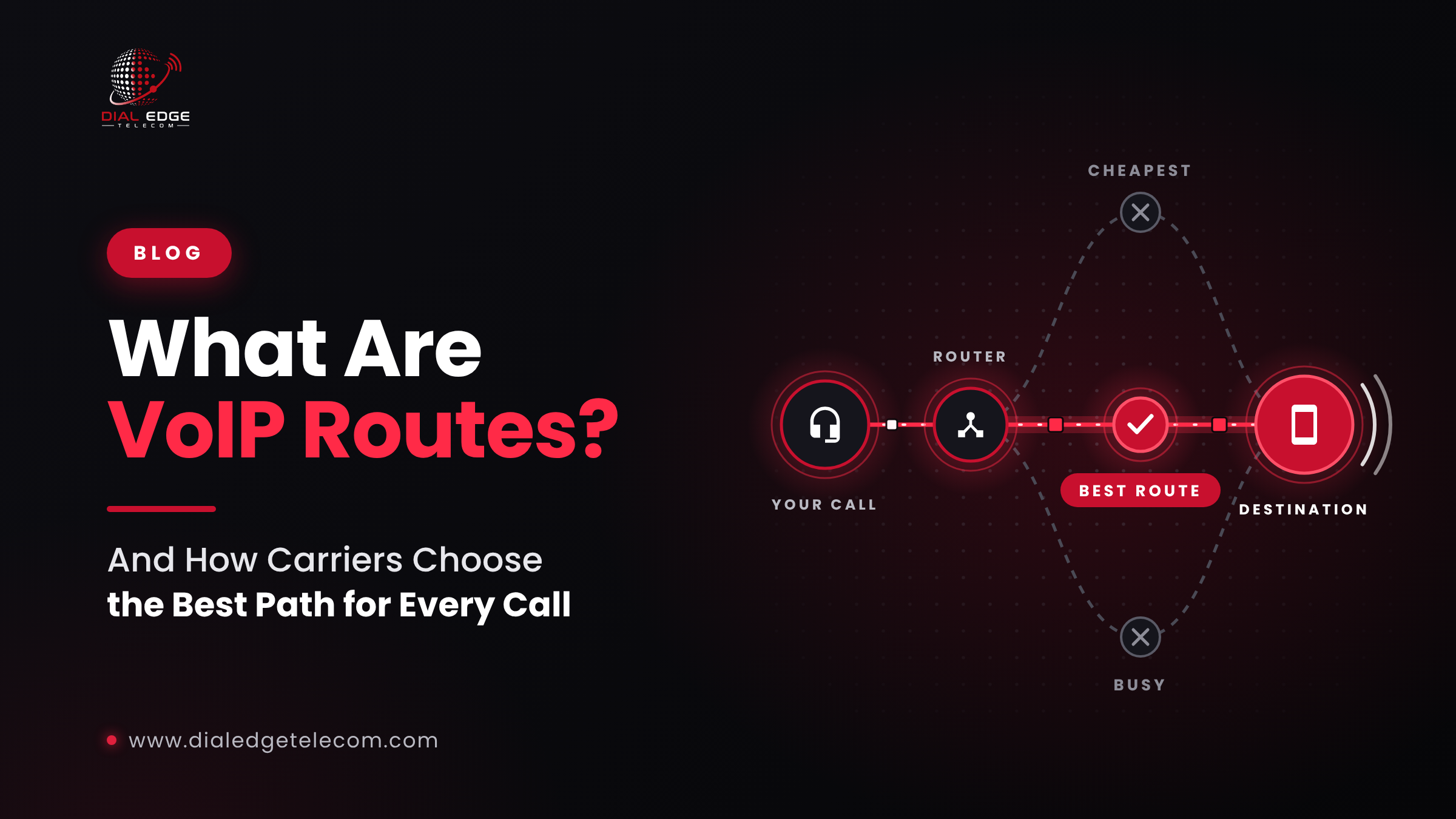
If a call fails on the first route (for example, the route is busy or temporarily down), the system automatically tries the next best option. This is called failover or route advance, and it happens so quickly that the caller never notices.
Putting it all together
For each call, a well-run carrier's routing system essentially asks:
Where does this number actually live?
Which routes can reach it?
Which of those meet our quality, capacity, and compliance standards?
Which of those gives the best balance of quality and cost?
If that one fails, what's next?
The answer is the route your call takes.
How to tell if your provider uses good routes
You can't see your provider's routing table, but you can see the results. Watch for:
Low answer rates or calls marked as spam
Long silences before the phone rings
Choppy, robotic, or one-way audio
Calls that drop mid-conversation
Caller ID that doesn't show correctly
And ask your provider:
Do you use direct, Tier-1, CLI routes for my traffic?
How do you monitor route quality, and how quickly do you replace poor routes?
Can I test routes with my own traffic before committing?
Can you share ASR and ACD reports?
Quality VoIP routes with Dial Edge Telecom
Dial Edge Telecom routes your calls over Tier-1 voice routes for call centers, carriers, and enterprises across the US and Canada:
Tier-1 voice routes for clear, consistent calls
99.99% uptime
Premium dialer termination built for high-volume traffic
Dedicated SIP trunks that scale with you
Transparent rates. No hidden fees.
Ready for better routes? Get a custom rate quote, email sales@dialedgetelecom.com or call +1-863-513-5237.